GEPCO Net Metering 2026 — Application, Cost & Payback
Net metering in Pakistan was replaced by net billing on 9 February 2026, when NEPRA notified the Prosumer Regulations 2026 and repealed the 2015 framework. Exported and imported units are no longer exchanged one for one. You now buy grid electricity at your normal tariff and sell surplus solar at a much lower buyback rate. Existing agreements signed before that date keep their original terms until expiry.
If you are researching solar in Gujranwala or Sialkot right now, that single change matters more than anything else on this page. Most solar guides online were written before it and still describe a system that no longer exists.
What changed
Under the old rules, a unit exported cancelled a unit imported. Your meter effectively ran backwards. Export 300 units during the day, draw 300 at night, and your energy charge was close to zero. That exchange is gone.
| Net metering (until Feb 2026) | Net billing (now) | |
|---|---|---|
| Export valued at | Same rate you pay | A separate, much lower buyback rate |
| Import billed at | Offset against export | Full retail tariff, slabs and taxes |
| Contract term | 7 years | 5 years |
| Settlement | Units | Money |
The buyback figure itself has been reported differently across the various notifications and ECC decisions — somewhere between roughly Rs 8 and Rs 11 per unit, tied to the national average energy purchase price. Retail domestic rates sit far above that.
Confirm the current buyback figure with GEPCO in writing before you sign anything. An installer’s quoted savings are only as good as the rate they assumed, and that rate has moved more than once this year.
Which category are you in?
This determines everything.
- Agreement signed on or before 9 February 2026. You are protected. NEPRA amended the regulations, with retrospective effect from that date, confirming that valid existing agreements continue on their original rate and mechanism until the contract expires.
- Material modification — adding panels, expanding capacity — can pull you out of those grandfathered terms and onto the new framework. If you have a good old agreement, think carefully before enlarging the system.
- Application submitted before 8 February 2026. Applications filed before the cutoff were confirmed for processing under the previous rules. If yours is in that window and someone tells you otherwise, ask for it in writing.
- Applying now. Net billing, in full.
How a net billing bill works
Two separate calculations, netted in rupees rather than units:
Payable = (Import units × your retail slab rate) − (Export units × buyback rate)
Here is the part almost nobody mentions, and it is the most useful thing on this page.
Your slab is set by imported units, not by total consumption.
A household using 500 units a month sits in a high slab. Put solar on the roof, cover 200 units directly from your own panels during the day, and you import 300 — which drops you into a lower slab, at a lower rate, on every one of those 300 units.
That slab drop is often worth more than the export credit. It also means the goal has flipped: reducing imports now beats increasing exports. Work out your current consumption pattern and what a lower import figure would cost with the GEPCO bill calculator before you decide on a system size. That number, not the installer’s brochure, is your baseline.
Three things that stop applications
Check all three before you take a quote.
- Your sanctioned load. The system capacity cannot exceed the San Load printed on your bill. A 10 kW system on a 5 kW sanctioned connection is not approvable. You would first need to apply for a load enhancement, which is its own application, its own survey and its own demand notice — and it raises your monthly fixed charge permanently.
- Your connection type. The framework is built around three-phase and 11kV consumers. A single-phase domestic connection generally needs upgrading first.
- Your area transformer. GEPCO checks whether the local transformer can absorb another connected generator. Where loading is already high — roughly 80% is the commonly cited threshold — the utility can refuse further interconnections on that transformer regardless of how good your paperwork is.
That last one is genuinely local. Two houses on the same street can get different answers.
The application, start to finish
- Engage a certified installer. They design the system and produce the single-line diagram. Equipment must be on the approved list, with an inverter carrying anti-islanding protection to recognised standards.
- Submit the application to GEPCO with your CNIC, a recent bill, system specifications, the single-line diagram, and an affidavit on stamp paper confirming compliance.
- Technical review, including transformer capacity. Systems at or above 250 kW require a load flow study, which adds time and engineering cost.
- Pay the demand notice. A licensing fee charged per kilowatt of installed capacity applies, so a larger system means a proportionally larger fee.
- Inspection and commissioning. A GEPCO engineer checks the installation, including surge protection on both the DC and AC sides, before issuing compliance.
- Bi-directional meter installed and the agreement executed, now for a five-year term.
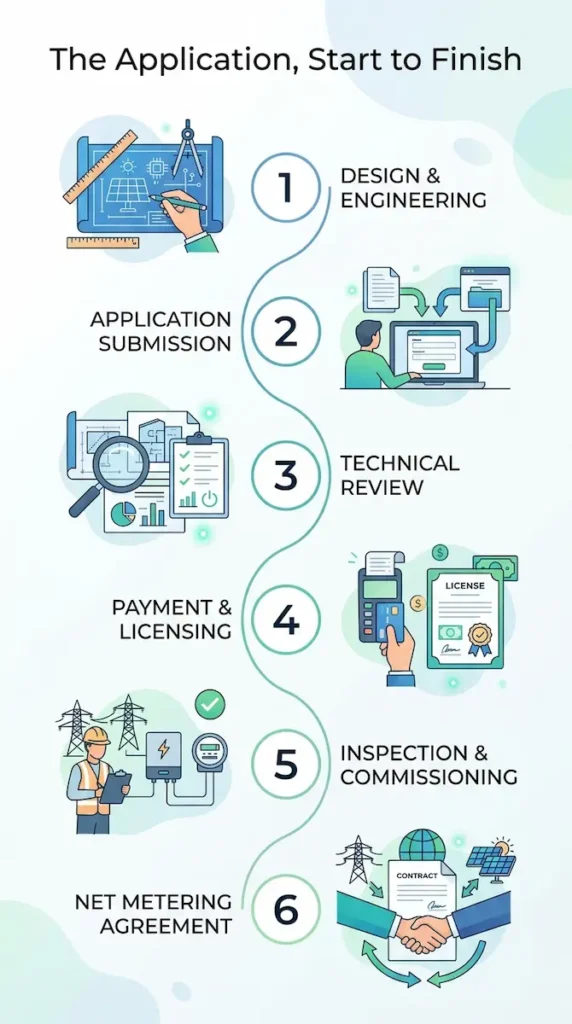
Realistic timeline: four weeks at best, three months where the file needs revision or the transformer needs assessment.
What it costs
Beyond panels, inverter and installation, budget for:
- The bi-directional meter
- A licensing fee charged per kW, so it scales with system size
- Surge protection devices on both sides, which inspectors specifically check
- Load enhancement, if your sanctioned load is short
- Three-phase upgrade, if you are on single phase
- A load flow study, for larger commercial systems
Ask for these as separate line items on any quote. Bundled “net metering charges” hide which of them you are actually paying for.
Sizing a system that still makes sense
The design that made money in 2024 loses money now. Oversizing to export was rational when export earned retail rate. It is not rational when export earns a fraction of it.
- Size to your daytime load, not your total load. Look at what you run between roughly 9am and 5pm — air conditioning, water pumps, shop machinery, office equipment. That is the consumption solar can offset at full retail value.
- Shift what you can into daylight. Washing, ironing, water pumping, welding. Every unit moved from evening to midday is a unit you don’t buy from the grid.
- Consider storage seriously. Storing daytime surplus and using it in the evening now retains far more value than exporting it. A battery costs money, but the arithmetic changed in its favour on 9 February.
- Gujranwala and Sialkot commercial premises are the strongest case in this region. A workshop or export unit running heavy load through the working day self-consumes almost everything it generates, which is exactly what the new rules reward.
Realistic payback
Anyone quoting a fixed payback period without seeing your bill is guessing. Payback now depends on four things: how much of your generation you actually use yourself, which slab your reduced imports land in, the current buyback figure, and installed cost per watt at the time you buy.
A household exporting most of its generation will see a considerably longer payback than it would have under the old rules. A commercial premises consuming most of its own generation may see very little difference, because its savings never depended on export in the first place. Ask any installer to show you the calculation on your bill, with imports and exports separated, and the buyback rate they assumed stated in writing.
Before you sign
Six questions worth asking:
- What buyback rate is this savings estimate based on, and where is that figure notified?
- What is my sanctioned load, and does this system exceed it?
- Have you confirmed capacity on my area transformer?
- Is the inverter on the current approved equipment list?
- Are surge protection devices on both DC and AC sides included?
- What is quoted for the licensing fee, the meter, and any load enhancement — separately?
An installer who answers all six clearly is one worth dealing with.
FAQ
Is net metering finished in Pakistan?
The 2015 net metering framework was repealed on 9 February 2026 and replaced by net billing under the Prosumer Regulations 2026. Existing agreements continue on their original terms until they expire.
I already have net metering. Does anything change for me?
Not while your agreement runs. But expanding the system can count as a material modification and move you onto the new framework, so get that confirmed before adding panels.
Where do export units show on my bill?
As a separate credit line, with imported units billed normally. The two are settled in rupees, not exchanged as units.
Is solar still worth installing?
For premises with substantial daytime consumption, yes — the savings come from not buying grid electricity, which is unaffected by the rule change. For a household planning to export most of its generation, the case is much weaker than it was.
Can I install solar without applying at all?
An off-grid or hybrid system with no grid export needs no net billing agreement. You simply don’t get paid for surplus. Given the buyback rate, that is a legitimate option worth pricing.